The Modernist and the Masons
As the Masonic Home at Covina evolves, renowned midcentury architect A. Quincy Jones’s vision guides a campus built for community and care.

By John Wogan
In downtown Detroit, the largest Masonic temple in the world looms over Grand River Avenue like a limestone citadel. To onlookers, it might appear to be part cathedral and part corporate headquarters for a regional powerhouse. Its towers rise in stepped Gothic tiers like something out of a superhero movie. Standing before it today, you can still register the ambition that must have informed its scale and a desire for visibility throughout the city. Completed in 1926, Detroit’s Masonic Temple is just one example of early-20th century architecture intended to convey the presence of the Freemasons, marking itself on the skyline as confidently as any bank or civic building. Up close, the building is harder to pin down. The facade is dense with pointed arches, tracery, and vertical setbacks that draw the eye upward, while the base spreads wide across the block. At ground level, it reads less like a private lodge than a place designed for constant use, with thousands of people coming and going.
This period, roughly the 1890s through the interwar years, produced a parallel urban silhouette. Alongside insurance towers and Beaux Arts courthouses rose monumental clubhouses—Masonic halls, Scottish Rite auditoriums, and Shriners temples occupied entire city blocks, their facades pulling freely from architectural history, incorporating Egyptian pylons, Corinthian colonnades, Venetian tracery, and Ottoman domes. The result may have lacked stylistic coherence, but it was a deliberate accumulation of buildings designed to suggest permanence, authority, and reach all at once. In his study of Masonic lodge rooms of this era, historian William D. Moore describes them as “a sacred space of masculine spiritual hierarchy,” where identity was shaped through ceremony and allegory.
Inside, members moved through carefully staged environments, from processional corridors and dim antechambers to richly decorated lodge rooms, each designed to heighten the experience of ceremony. Outside its walls, that presence came through just as clearly.
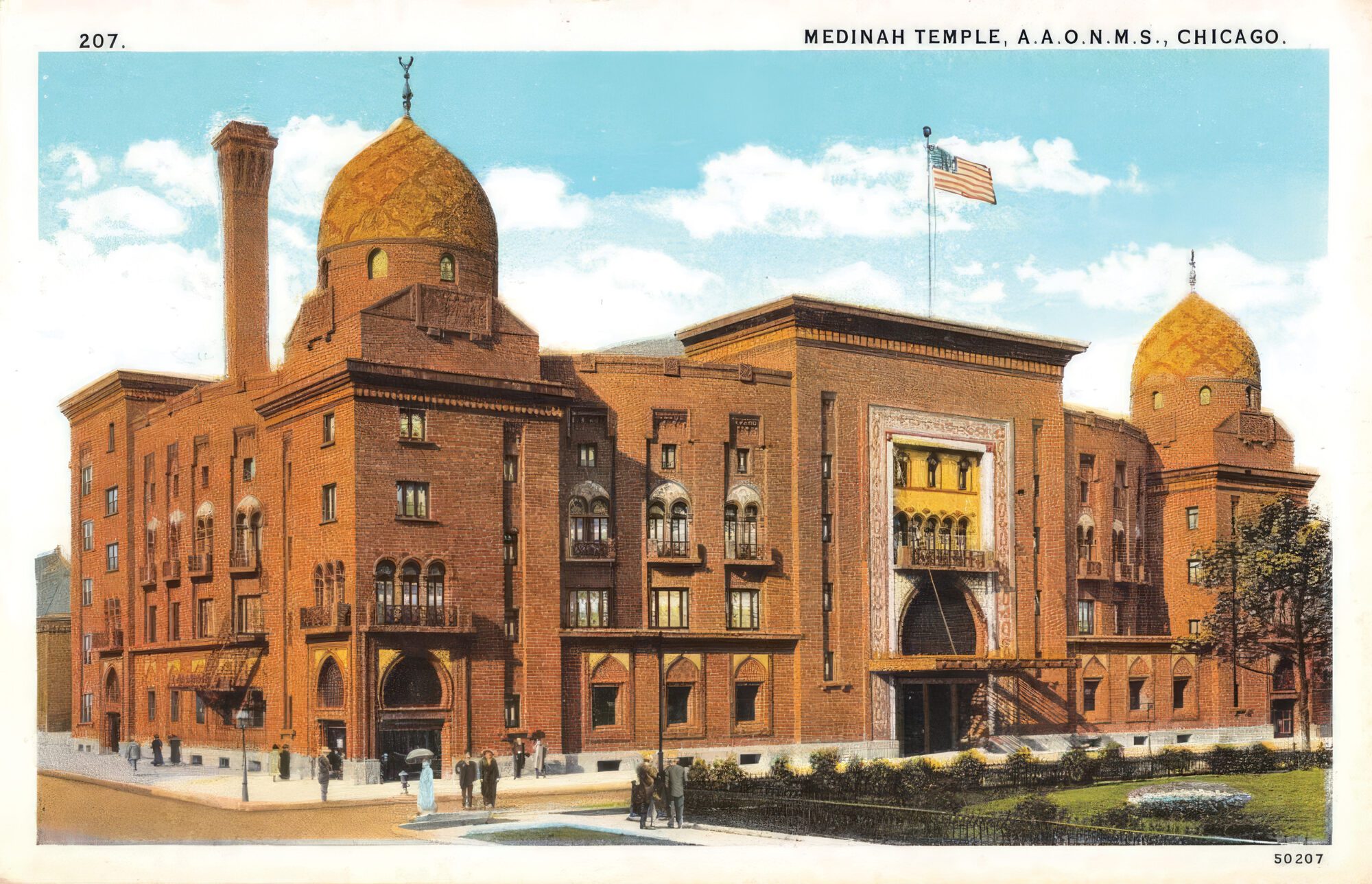
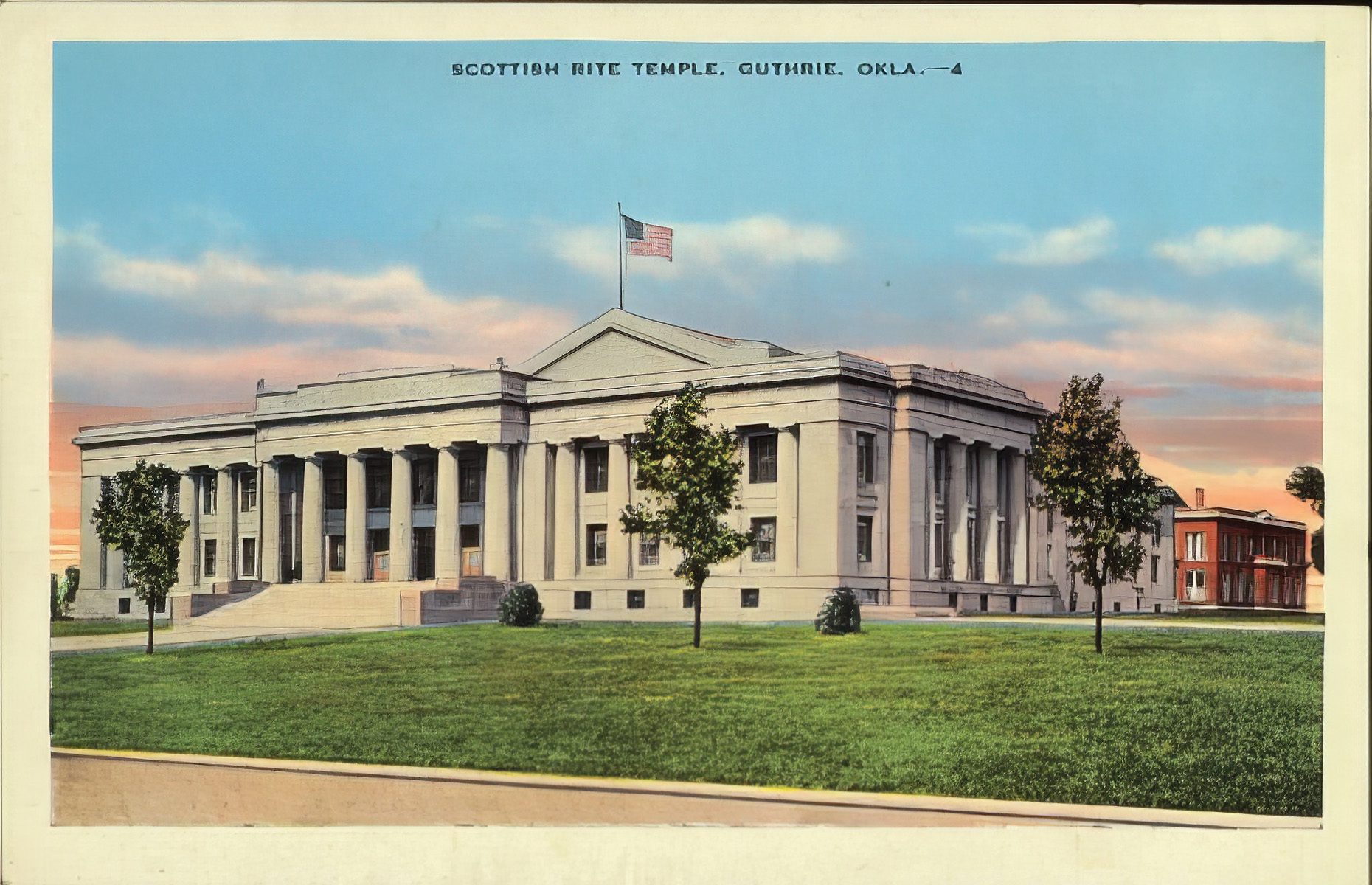
These fraternal organizations inserted themselves into the rapidly changing modern American city, constructing at a scale that placed them alongside institutions of finance, government, and culture. Adam Kendall, former executive director at the Oakland Scottish Rite Historical Foundation, and a past master of Northern California Research Lodge and Phoenix № 144, places them squarely within the urban expansion that produced early skyscrapers. But the massive size of the structures wasn’t simply symbolic. It was also practical. “If you look at migration patterns at the time,” he says, “people were moving into cities like Detroit in large numbers. These organizations were growing alongside that.” By the 1920s—a period sometimes referred to as the Golden Age of Fraternalism—millions of Americans belonged to Masonic or affiliated groups, drawn by the professional connections, social services, and sense of community they offered. (It’s also worth noting that while most of these monumental structures were built in cities, there were occasional outliers. Nowhere is this ambition of scale more curious than in Guthrie, Oklahoma, where the Temple of the Scottish Rite of Freemasonry—a colonnaded neoclassical complex completed in 1929—rises improbably from within a town of fewer than 15,000 people.)
Multiple lodges met weekly, sometimes nightly, with overlapping calendars of initiations, lectures, charitable planning, and social events. For many members, temple activities were as routine as going to work or church on Sunday. In industrial cities, where new arrivals often lacked established networks, these organizations offered structure: a place to meet, advance professionally, and feel part of a community. The architecture followed accordingly. Large auditoriums accommodated degree ceremonies involving dozens of participants; dining halls supported banquets; corridors were sized for simultaneous meetings happening on multiple floors. What might read today as excess was, at the time, a matter of practicality.
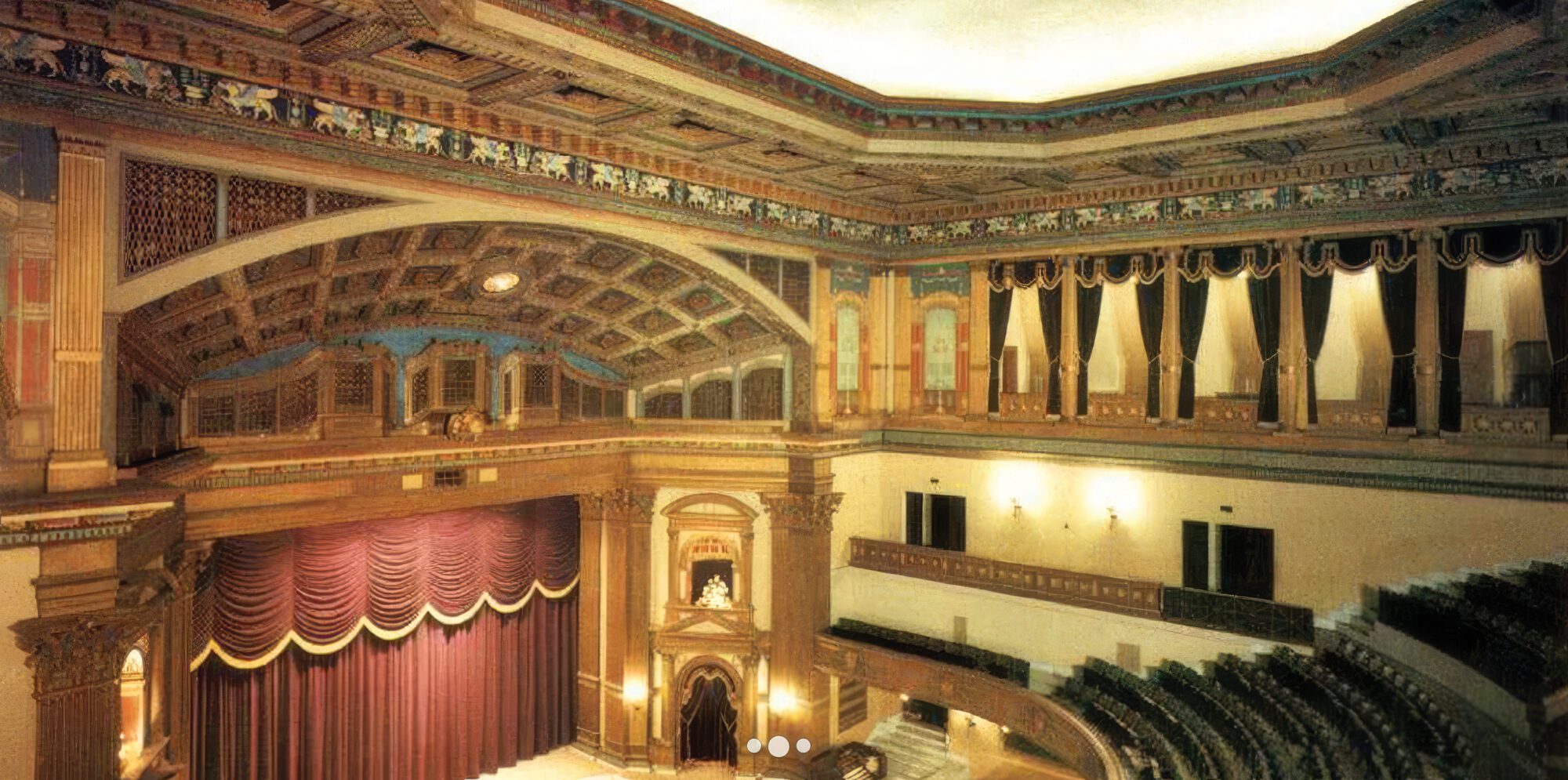
Nowhere was that logic pushed further than in Detroit. By the mid-1920s, the city’s Masonic membership had reached roughly 35,000 men, composed of craftsmen; machinists working at General Motors, Ford, or the Chrysler Corporation; and executives. Their existing temple on Lafayette Boulevard, which had seemed so ambitious when it opened in 1896, had already been outgrown. The association acquired a new block on what was then called Bagg Street (later renamed, naturally, Temple Avenue) and broke ground on Thanksgiving Day 1920, eventually producing a 550,000-squarefoot complex with 1,037 rooms and three theaters. “We needed it,” says Matt Shelton, a member of Pontiac Lodge № 21 and a docent with the Detroit Masonic Temple Library. “There were 35 lodges meeting in the building when it opened. There wasn’t space anywhere else.” The architect, George D. Mason, was himself a 32nd-degree Mason, a fact that probably didn’t hurt when the commission was being decided. He chose Gothic Revival, unusual for Masonic buildings, which more commonly looked to Egypt or Greece for inspiration. Mason reportedly believed that the Gothic style best captured the organization’s origins in medieval stonemason guilds. The cornerstone was laid in 1922 with the help of a trowel George Washington had used at the U.S. Capitol, a gesture of historical continuity. Inside, Mason brought in sculptor Corrado Parducci to design the lobby, which was modeled on a castle he had toured in Palermo. The building opened its theater with a performance by the Detroit Symphony Orchestra, conducted by Ossip Gabrilowitsch, in February 1926. Formal dedication followed that Thanksgiving.
To examine the building now is to understand how deliberately it was overbuilt. Seven lodge rooms each display a different decorative style, including Egyptian, Byzantine, Romanesque, and Gothic. The main theater seats more than 4,000 people its stage among the largest in the country. There is also a drill hall with a sprung floor, two ballrooms, and, somewhere in the building, a never-completed third theater. The place still operates today, hosting concerts, roller derby in the drill hall, and weddings in the Crystal Ballroom. Blues-rock icon Jack White, a Detroit native who grew up watching his mother usher there, paid off $142,000 in back taxes in 2013 to keep it solvent. The building now bears a theater in his name.
Above: Ascending 302 feet, the 1892 Chicago Masonic Temple building was arguably the tallest Masonic temple ever built, and for a time, the tallest building in Chicago. The early Chicago School skyscraper contained lodge rooms, theaters, offices, shops and a public observatory. It was demolished in 1939.
Philadelphia’s Masonic Temple, completed in 1873, predates Detroit’s by a half century but displays the same impulses. The building sits at 1 North Broad Street, directly across from where City Hall would eventually sit, and that positioning was not accidental. The commission went to James Windrim, a 27-year-old Mason who beat out, among others, Frank Furness and James McArthur, the architects who would go on to design Philadelphia’s Academy of Fine Arts and City Hall, respectively. Windrim’s Norman Revival exterior, made of austere granite, with towers reaching 232 feet, reads as institutional from the street, almost like a government building. The front gates are 17 feet high.
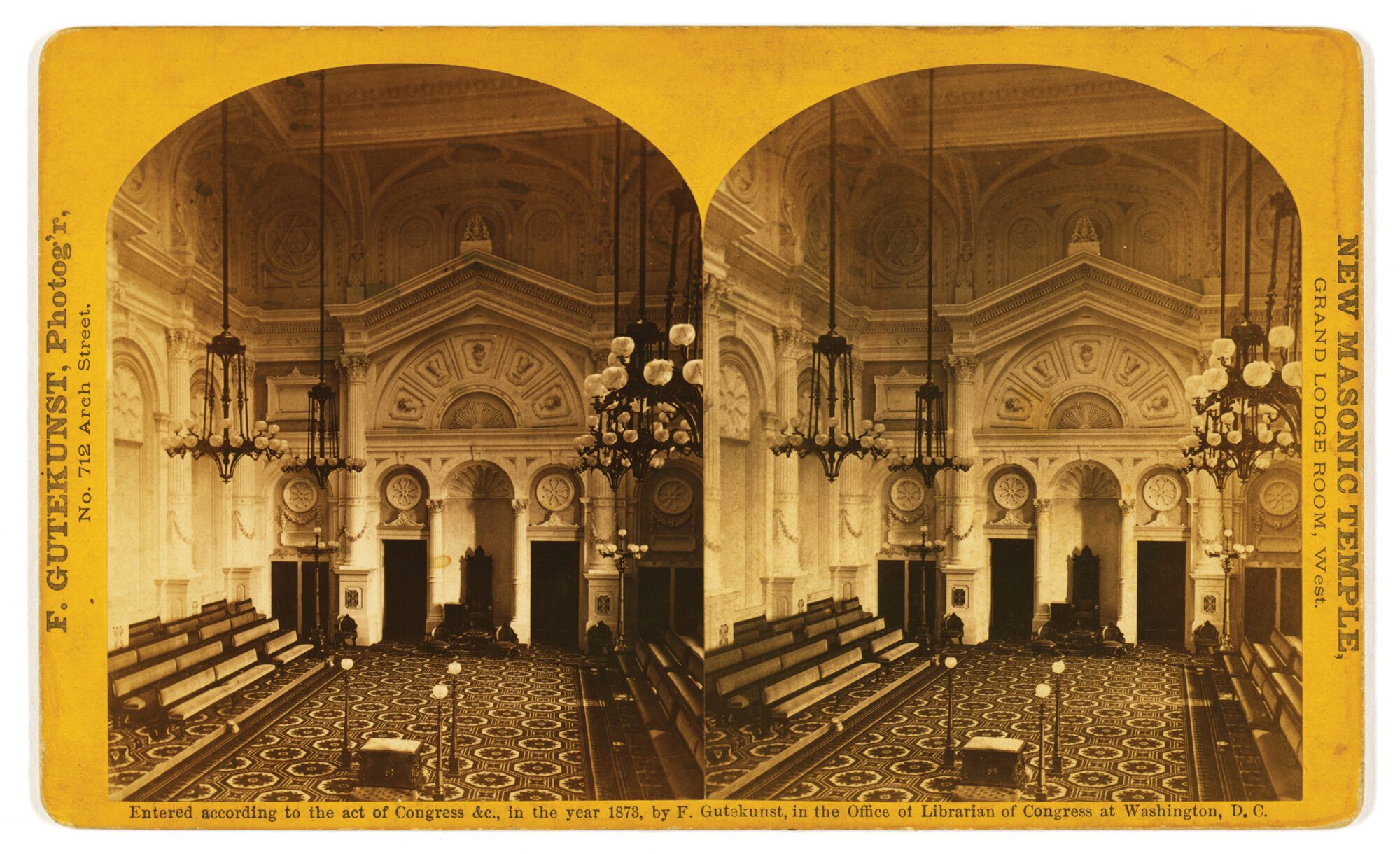
Inside, it follows a similar pattern. The seven lodge rooms, designed largely in the 1880s and 1890s by German-born decorator George Herzog, each adopt a different architectural language: Egyptian, Ionic, Norman, Corinthian, Renaissance, Oriental, Gothic. Work continued until 1908, and moving between the various spaces now feels less like touring a single building than passing through a curated sequence of eras and genres. In the Egyptian Hall (the first to be finished and still the crowd favorite on tours), columns are painted in saturated bands of color, their capitals flaring beneath a ceiling covered in mason’s marks, a medieval practice of signing work. The Corinthian Room shifts toward simplicity, a cooler palette, and more formal symmetry. The contrast between them is deliberate: Each space reinforces a different phase of the organization’s self-mythologizing, its claim to an unbroken tradition running from ancient Egypt through classical Greece to the modern Philadelphia.
Kendall describes this kind of interior as “fantasy architecture.” Not escapism, but a layering of historical references assembled to suggest meaning and authority. The Masons, he notes, drew from Enlightenment ideals, classical philosophy, and medieval guild traditions simultaneously, and their architecture didn’t unify those references so much as keep them all in productive tension.
Freemasons’ Hall in London, built between 1927 and 1933, makes a different kind of statement. The previous hall on Great Queen Street had been weakened by fire, and plans to replace it were already forming before the First World War interrupted everything. After the armistice, the project was revived with a new purpose: The building would serve as a memorial to the 3,225 Freemasons who had died in the conflict. They initially called it the Masonic Peace Memorial. The winning design, selected through a competition judged in part by renowned British architect Edwin Lutyens, came from Henry Victor Ashley and F. Winton Newman—relatively modest figures known mainly for banks and civic offices. The project was funded by contributions from lodges and individual members, incentivized by commemorative tokens; silver for ten guineas or more, gold for a hundred.
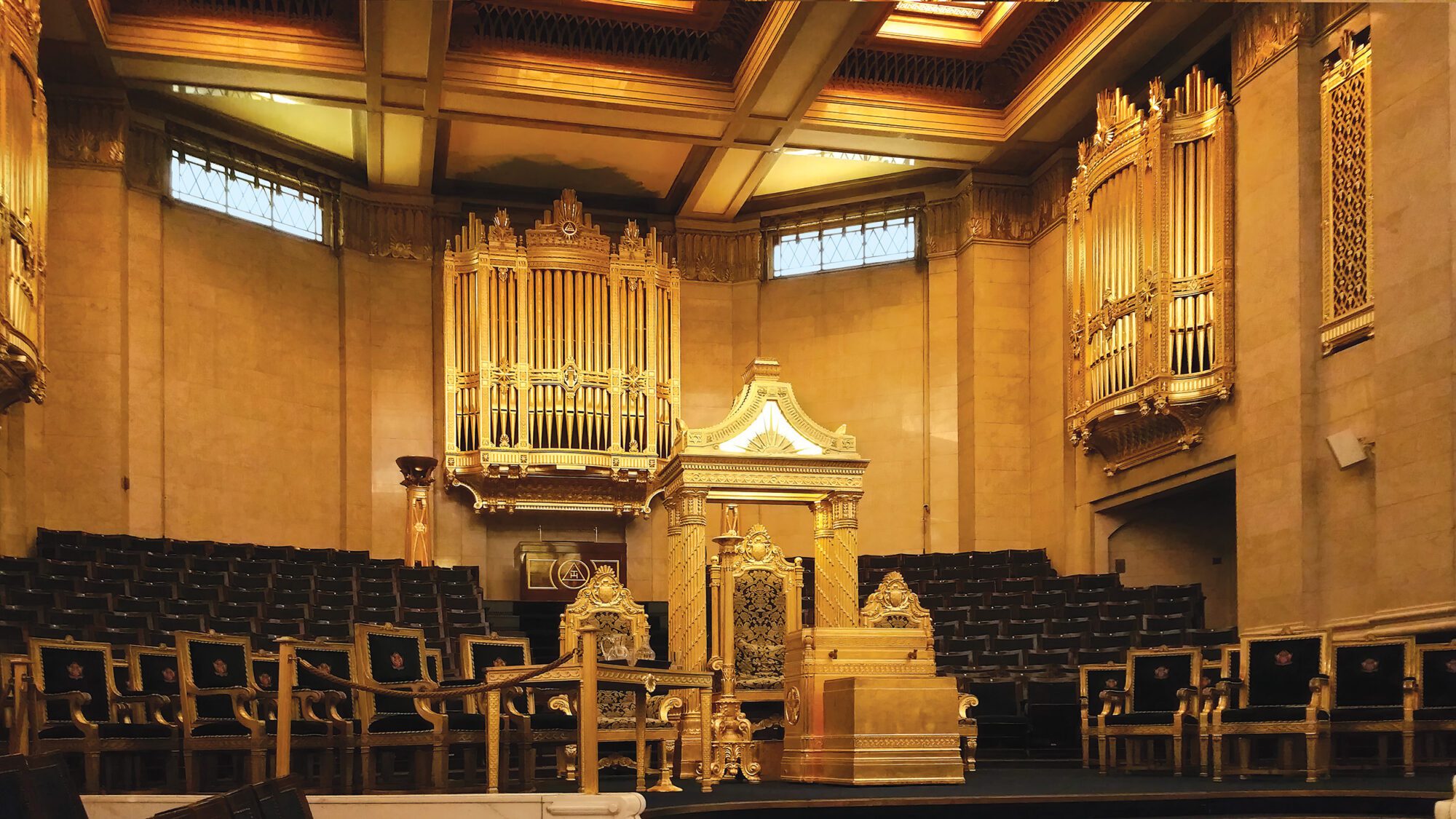
The exterior is Portland stone, and more pared-back than in its American counterparts. Where Detroit announces itself through Gothic mass and Philadelphia through Norman bulk, London opts for something closer to civic authority, with fluted piers, a tower that reads as a pylon, and sculptural figures representing peace and progress flanking the entrance. Inside, past bronze doors weighing over a ton each, the Grand Temple opens into a space that seats 1,700 beneath a coffered ceiling inlaid with gold stars on deep blue, its proportions forming a perfect cube—a form with symbolic weight in Masonic tradition. The mosaic ceiling coves depict the four cardinal virtues. The organ, installed by Henry Willis and Sons in 1933, comprises 2,200 pipes. The overall effect is less theatrical than London’s other great institutions, as if expressing that it expects to be taken seriously.
Together, these three buildings assert that belonging is not a private matter, or at least it doesn’t have to look like one. Their facades face streets lined with banks and government buildings, in effect saying, “We are also of this realm.” The irony is pointed. Organizations defined by private ritual chose to declare themselves through the most public architectural language. “People look at these buildings and assume something secretive is happening,” Kendall says. “The scale reinforces that.”
By the 1960s, the conditions that made these buildings possible had largely dissolved. Suburban migration dispersed membership; newer forms of social life replaced fraternal ones. Part of Detroit’s temple became the city’s concert hall. London’s fills with tourists and film crews—its interiors have stood for various august institutions across decades of filmmaking, including the headquarters of the Illuminati in 2022’s Doctor Strange in the Multiverse of Madness, an underground initiation site in 2009’s Sherlock Holmes, and a Madrid art gallery in Muppets Most Wanted from 2014. Philadelphia still hosts 28 active lodges and is meticulously maintained. All three have survived by becoming, in some sense, what their exteriors always suggested they were—public buildings, civic landmarks, and places that belong to the city as much as to the fraternity. A century on, that turns out to have been the point all along.
Illustration by:
Eddie Guy
Photo courtesy:
APK/CC3
Diego Delso
Library of Congress
Temple of the Scottish Rite of Freemasonry
Guthrie
As the Masonic Home at Covina evolves, renowned midcentury architect A. Quincy Jones’s vision guides a campus built for community and care.

At the Masonic Homes, brain-health research is informing a new model ofmemory care built around preferences, patterns, and purpose.

From social events to philanthropy, Elk Grove Lodge № 173 is growing again and boosting engagement, driven by “time, treasure, or talent.”