The Modernist and the Masons
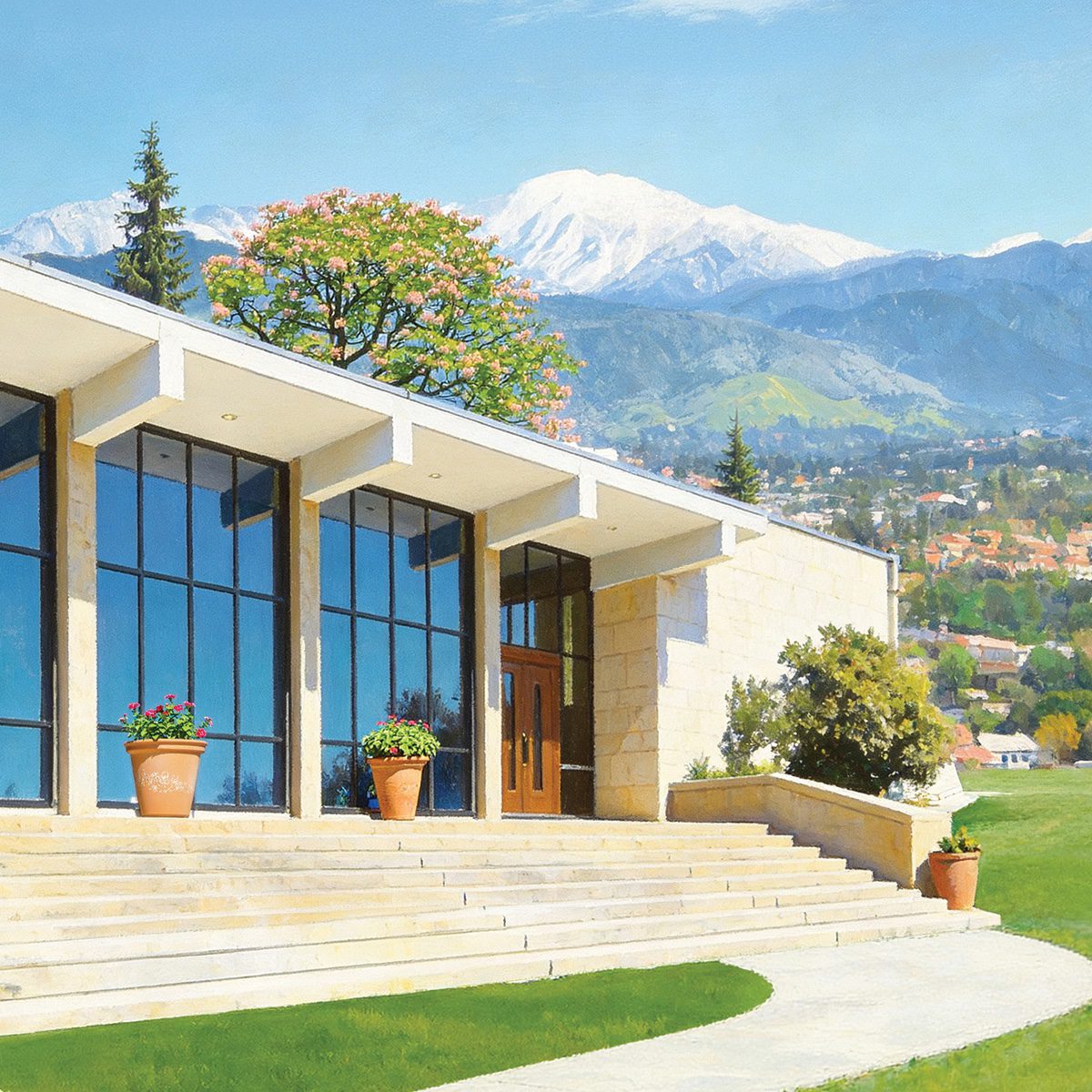
As the Masonic Home at Covina evolves, renowned midcentury architect A. Quincy Jones’s vision guides a campus built for community and care.

By Shane Reiner-Roth
Above: The geometry of the Pantheon brings circle, square, and sphere into alignment. Crowned by an oculus open to the sky, the building embodies the ancient idea of an axis mundi—a connection between the earthly and the divine.
Long before it was applied to buildings, geometry offered Freemasons a way to discern order in the world around them. “By geometry, we may curiously trace Nature, through her various windings, to her most concealed recesses,” wrote 18th-century Freemason William Preston, linking those formulas to what Masons call the Great Artificer of the Universe and to “the proportions which connect this vast machine.” In time, those ideas would find expression in the spaces they built.
For Masons, sacred geometry is less a fixed system than a way of working—one grounded in a long architectural lineage, where proportion and meaning are held in balance. Kevin Hackett, co-principal of the San Francisco architecture firm Síol Studios and a member of both Logos № 861 and Mission № 169, defines it not as a formula or a “magic wand,” but as an “emergent” spatial order revealed through engagement with a specific site and guided by certain fundamentals.
Is it any wonder, then, that Freemasonry—with its emphasis on order, proportion, and meaning—took such a firm hold in California so early in the state’s history? During the Gold Rush, from 1848 to 1855, the promise of wealth drew pioneers westward in search of opportunity. They lived in dusty Sierra Nevada boomtowns, replete with hastily built wooden structures, crowded saloons, and makeshift tents clustered along riverbeds, where fortune seekers panned for gold with no guarantee of success. Life was defined by grueling labor and constant movement, and communities often dissolved as quickly as they formed. Amid such instability, lodges offered constancy and a place to gather, with shared rituals that coaxed meaning from unpredictable circumstances.
For Freemasons arriving in California, the landscape itself could be read through the geometric lens Preston describes—order in light, terrain, and plant life. More than the conditions of the Gold Rush itself, that outlook helped shape the fraternity’s early presence in the region. The opening of the Grand Lodge of California on April 10, 1850—five months before California became the nation’s 31st state—marked the formal establishment of Freemasonry in the region. Later that year, Masons designed Benicia Masonic Hall, the first purpose-built lodge in the state, in a Greek Revival style clad in donated lumber. Within that structure, sacred geometry moved from abstraction into physical expression. Large windows brought sunlight into the interior, creating a shifting interplay of light— echoing Masonic associations of enlightenment and moral clarity.
The fraternity constructed more than 100 Masonic halls throughout the state within a decade. Each served as both a literal and a symbolic cornerstone of the surrounding community, among the most permanent and carefully constructed buildings of the era. Collectively, they signaled stability and aspiration.
Take a walk around—and through—the California Masonic Memorial Temple in San Francisco, and you’ll find an architectural expression that looks entirely different from its 19th century predecessors, yet carries forward the same underlying logic. Completed in 1958 by architect Albert Roller, the modernist structure commands Nob Hill through simple lines, planar surfaces, and materials—concrete and stone—full of gravitas.
“The temple committee required that the design stand as a timeless monument without stylized tradition or cliché,” Síol Studios’ Hackett says. Roller responded with a stripped-down modernist vocabulary—one that set aside overt iconography but retained the kind of geometric discipline at the core of Masonic design. Here, geometry operates less as symbol than as structure, expressed through proportion, alignment, and mass. The result is continuity of principle rather than form.
In 2019, Hackett’s firm completed Freemasons’ Hall, a subterranean gathering space within the California Masonic Memorial Temple. Its design brings sacred geometry to the fore, adhering closely to the phi principle—also known as the golden ratio—with dimensions calibrated throughout the space. “Every single detail follows that language,” Hackett says, “down to the micro-cornice.”
Geometric motifs recur throughout the space, whose cardinal orientation reflects the movement of the sun—a remarkable gesture for a space set below ground. Other elements carry more explicit meaning: The Dawn Wall, shifting from rough to smooth marble, evokes moral refinement, and a pentagon-shaped altar references what Hackett describes as “spiral creation” rooted in the phi ratio. Custom brass screens layer concentric forms, and the acoustics are tuned to produce a resonant, contemplative sound. The effect is immersive, with proportion, material, and light working together to encourage reflection.
Bruce Rawles, author of 2012’s The Geometry Code, defines sacred geometry as a way of understanding the underlying unity of the universe. “The principle of interconnectedness is what makes things sacred,” he says. “Sacred geometry is not really any particular object or form, but the idea behind it.”
The phi ratio occurs across natural and human-made systems—from the spiraling seed heads of sunflowers to the proportions of the human body. Its power lies in its consistency.
Well before Freemasonry took shape, these ideas were put to use by generations of architects, mathematicians, and philosophers working from a shared set of principles. Rawles points to the Great Pyramid of Giza, completed more than four millennia ago, where the phi ratio appears throughout its design. “The slanted height of the pyramid compared to half the base clearly demonstrates the golden ratio,” he notes. The precision points not just to technical mastery but to an effort to give abstract order physical form.
Solomon’s Temple—completed in 957 BCE in Jerusalem—serves as a central allegory. Its orientation to the cardinal points and its use of proportion are often read in similar terms. Most lodges feature two ornamental pillars, Boaz and Jachin, recalling the great columns that once stood at the temple’s porch and representing the union of heaven and earth.
In ancient Greece, geometry was the shared language of art and science. The philosopher Plato described a cosmos governed through reason, while Euclid, known as the “father of geometry,” established principles that continue to shape architectural thinking. The Pythagorean theorem—known in Freemasonry as Euclid’s 47th Problem—remains a symbol of order and integrity.
Those ideas were adopted by the Roman architect Vitruvius, who described architecture as a way of giving physical form to universal patterns. “All machinery is brought forth from the nature of things,” he wrote in the late-1st century BCE, “and founded on the teaching and guidance of the revolution of the universe.”
The Pantheon, built in Rome in the 2nd century CE, is often cited as one of the clearest expressions of geometric order in architecture. Its dome and interior form a perfect sphere, while the oculus above tracks the movement of sunlight across the space over the course of a day. Centuries before the term sacred geometry emerged, the building demonstrated how proportion and light could shape both atmosphere and experience.
Central to Vitruvius’s thinking was the belief that design should reflect the proportions of both the human body and the larger world. In his treatise, De Architectura, his description of a man inscribed within a circle later informed Leonardo da Vinci’s Vitruvian Man. By placing the figure within both a circle and a square—often read as symbols of the divine and the earthly, respectively—da Vinci gave visual form to the idea of man as a microcosm.
That legacy continued in the Renaissance work of Venetian architect Andrea Palladio. His Four Books of Architecture were so revered by early Freemasons that they were sometimes read in place of Masonic constitutions. For Palladio, architecture was a “will to knowledge through form.” He identified the circle as the most perfect form, symbolizing unity and the infinite. At Villa La Rotonda, just outside Venice, a central oculus draws light evenly into the space, reinforcing the building’s symmetry and geometric balance.
These shapely traditions resurfaced in Enlightenment Britain (1685–1815), where early Freemasons sought to replace “Gothick Rubbish”—so dubbed by the influential Scottish Freemason James Anderson—with a return to classical order. The English architect John Soane, a neoclassical specialist, applied symmetry, proportion, and spatial clarity to projects like Letton Hall in Norfolk.
British architect and astronomer Sir Christopher Wren approached architecture in similar terms, treating his plans as “spiritual trestle-boards.” In buildings such as the Wren Library in Cambridge, that discipline appeared in ordered facades and measured proportions. The tools of geometry—the square, compass, and level—also carried symbolic weight, tied to ideals of self-refinement.
In the 20th century, sacred geometry took on new forms. Swiss modernist Le Corbusier overlaid both historical and contemporary designs with what he called “regulating lines”—guiding geometries used to organize a building’s proportions and composition. His Modulor—a spatial system based on the human body—extends Vitruvian ideas into the modern world, as seen in projects like the Unité d’Habitation in Marseille, where proportions guide everything from room dimensions to the spacing and repetition of windows across the facade.
Throughout California, these ideas surface in diverse forms. The classical symmetry and Greco-Roman allusions of the State Capitol are drawn from the pages of Vitruvius and Palladio, while the monumental dome at its center brings natural light to the ground floor. In San Francisco, the Cathedral of Saint Mary of the Assumption, designed by Italian architects Pier Luigi Nervi and Pietro Belluschi in 1971, joins together eight 190-foot hyperbolic paraboloids in a sweeping manifestation of the transition from the earthly to the divine.
Sacred geometry moves across forms and periods, appearing wherever proportion, light, and structure converge. And while no two Freemasons define it quite the same way, it rarely resides in any one element. It shows up in the way parts align, how light enters a room, and how a structure holds together. Architecture is one way of making those relationships visible—not as a fixed formula, but as a pattern that repeats, shifts, and reappears across time.
By Angel Millar
Freemasonry makes extensive use of building metaphors. Masons speak of erecting “temples to virtue,” of chipping rough edges from the ashlar of character, and of fitting themselves into the “house not made with hands.” At the inner door of the lodge stand two columns, a motif also found in the medieval English manuscripts known as the Old Charges—records of stonemason mythology, circa 1450, from which Freemasonry drew.
Masonic emblems likewise derive from stone-masonry: the trowel, plumb line, square, and compass. The 24-inch gauge refers to the 24 hours of the day, divided between work, rest, and service to God and humanity. These symbols point to what Freemasonry calls the Great Architect of the Universe—its term for God, the source of order in both the natural world and the built environment. Geometry gives that idea form in the ratios and relationships that govern structure and meaning. Here are a few of the most enduring examples.
In his 1723 text Constitutions of the Free-Masons, Scottish minister James Anderson describes the 47th Problem of Euclid—also known as the Pythagorean theorem—as “the foundation of all Masonry.” Anderson meant stonemasonry, but in Freemasonry what’s practical becomes symbolic.
In the craft, the 47th Problem is said to be emblematic of the arts. In stonemasonry, it was used to map out the right angles of any building to be constructed. The method was simple: Divide a cord into 12 equal parts and pull it tight to produce a right triangle, its sides measuring three, four, and five units. The cord triangle could be fixed with three poles or held in place by three stonemasons. Since early Freemasons drew a rectangular “lodge” on the floor of their meeting places, they would almost certainly have marked its corners this way. The three officers of the lodge and their corresponding columns, the three lesser lights around the altar, even the cord running around the edge of many Entered Apprentice tracing boards, all echo this practice.
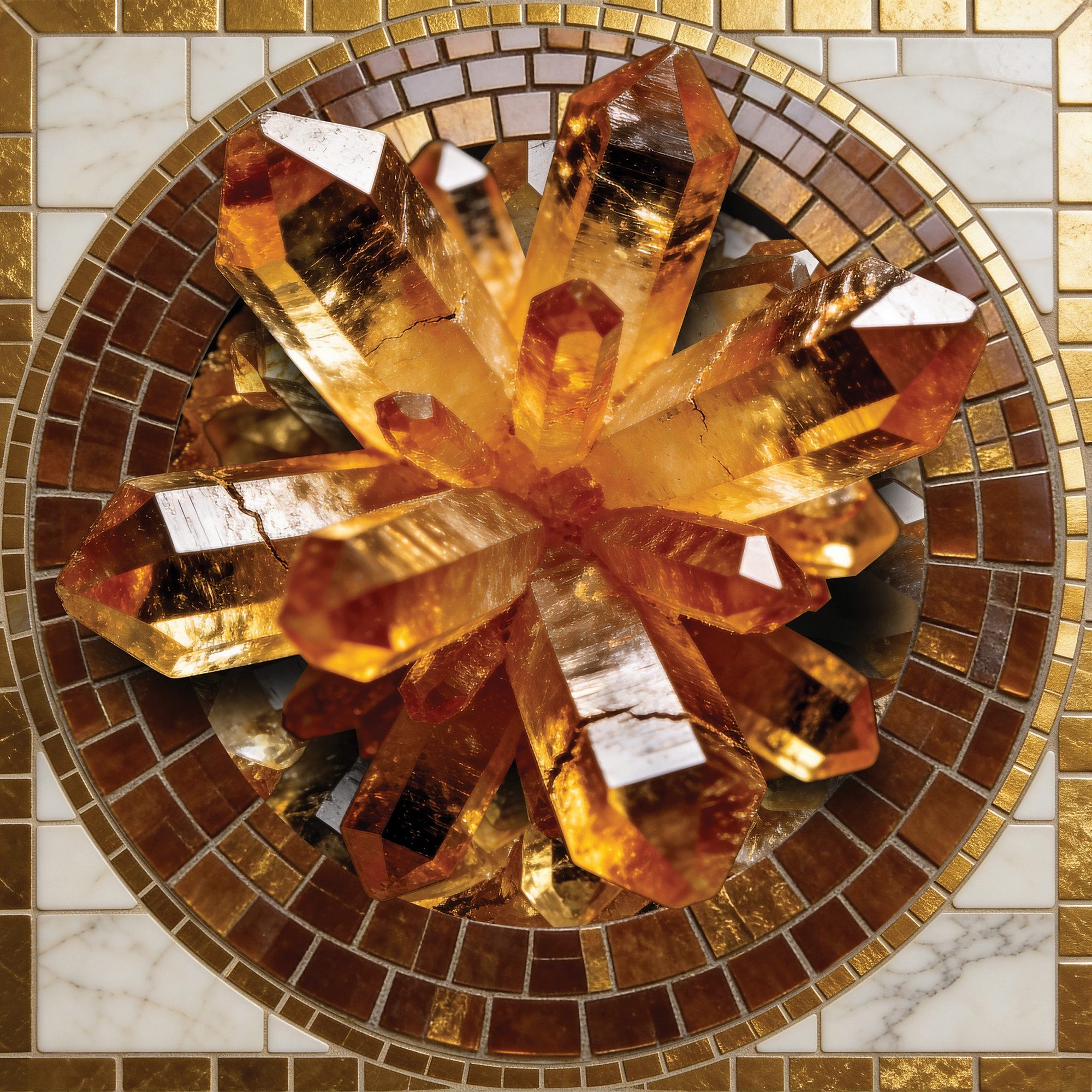
These same geometric relationships can also be found throughout the natural world, helping describe the spacial patterns that govern everything from crystal formations to branching structures.
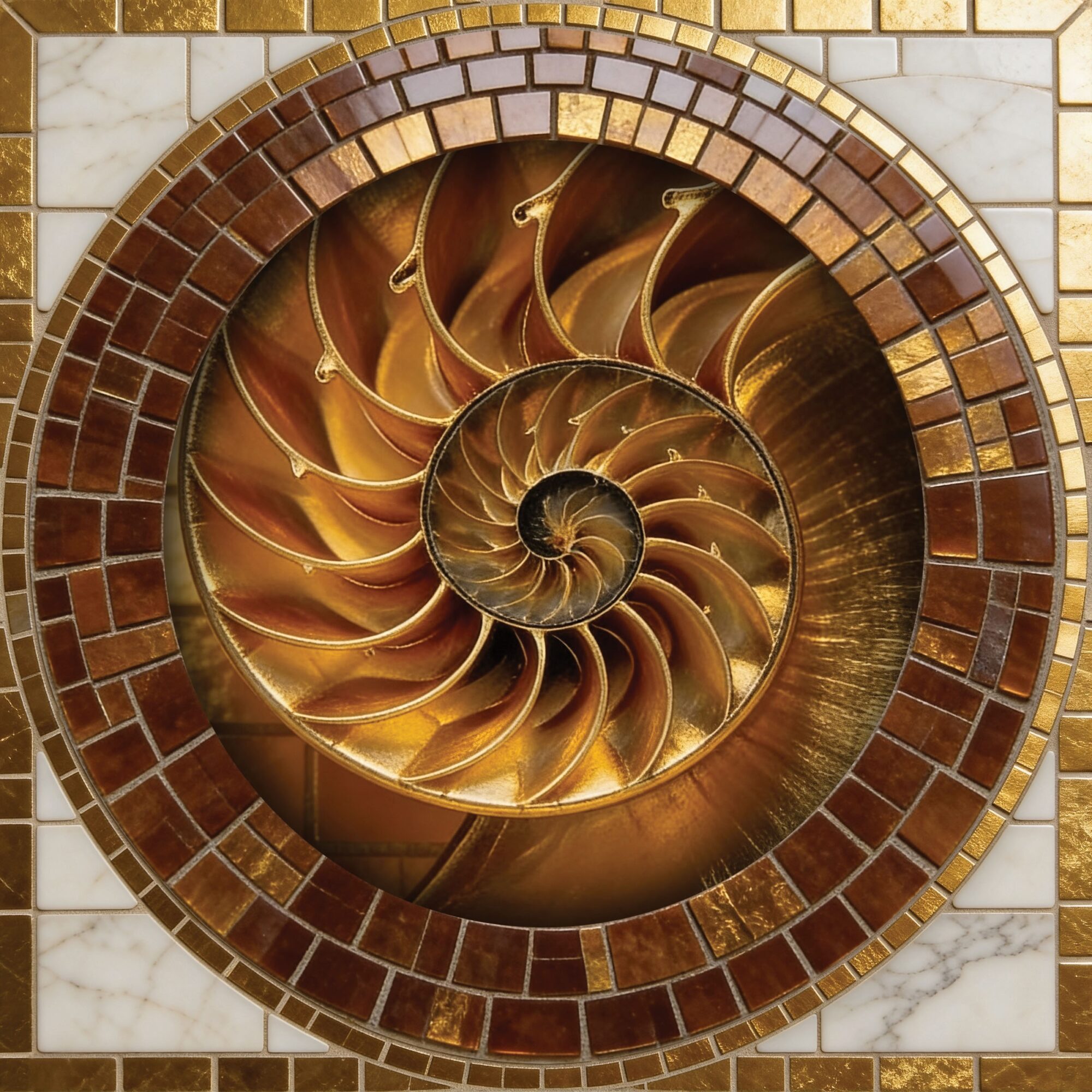
Also known as the divine proportion or phi ratio, this formula is most often represented by the Fibonacci spiral, and is widely associated with patterns both in nature and in human designs, from the whorls of shells to the facade of the Parthenon and, in some interpretations, the proportions of the nave at Our Lady of Chartres Cathedral. The golden ratio is often associated with a sense of balance in architecture. Approximately 1.6180339887, it’s an irrational number that neither terminates nor repeats, and can be found within the intersecting lines of a pentagram.
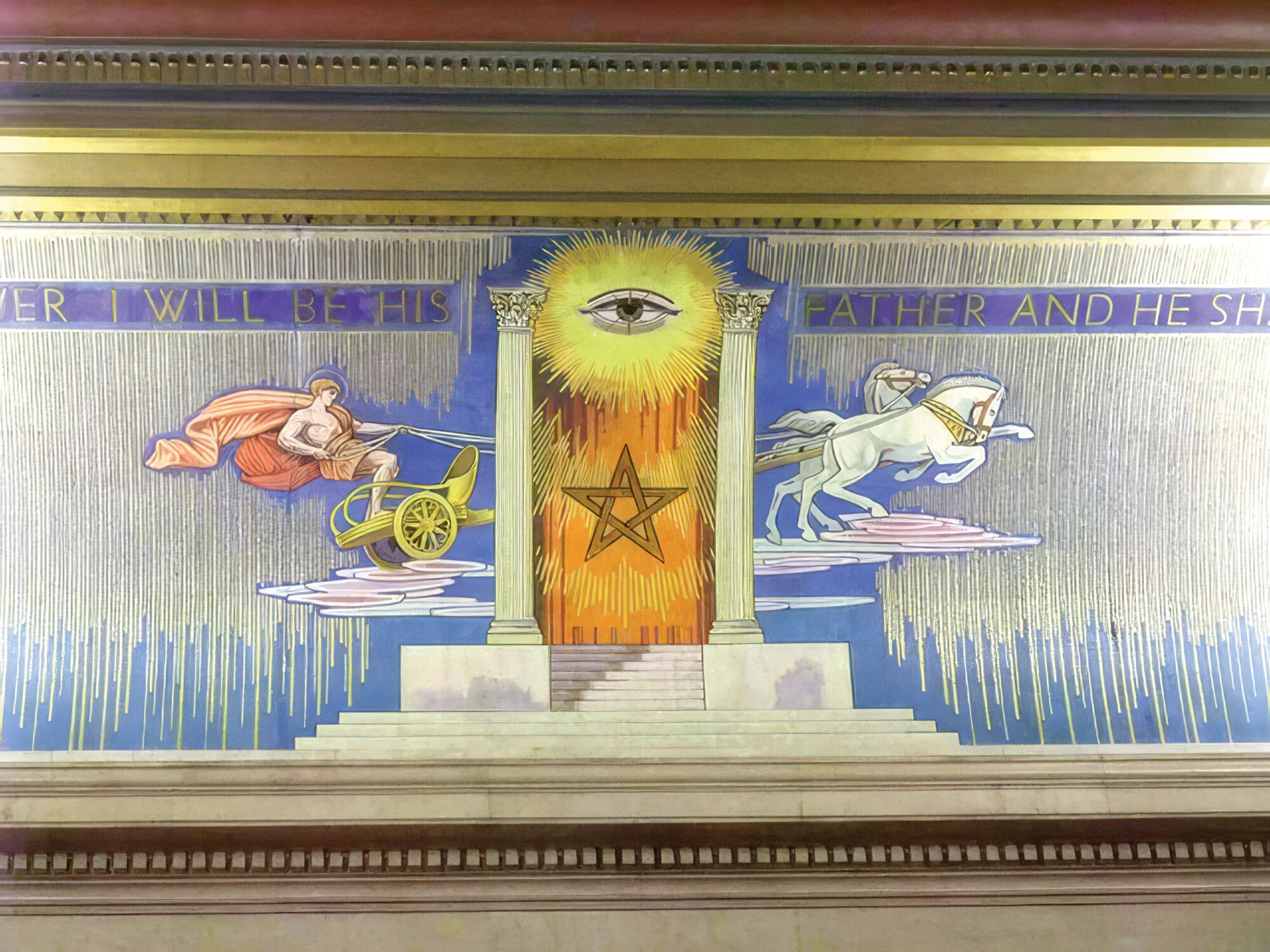
Notably, at Freemasons’ Hall in London, a large pentagram is embedded at the entrance. It’s also visible in some old Masonic illustrations and Masonic aprons, where it was used to represent the blazing star of the Great Architect or, as he is also known, the Grand Geometrician.
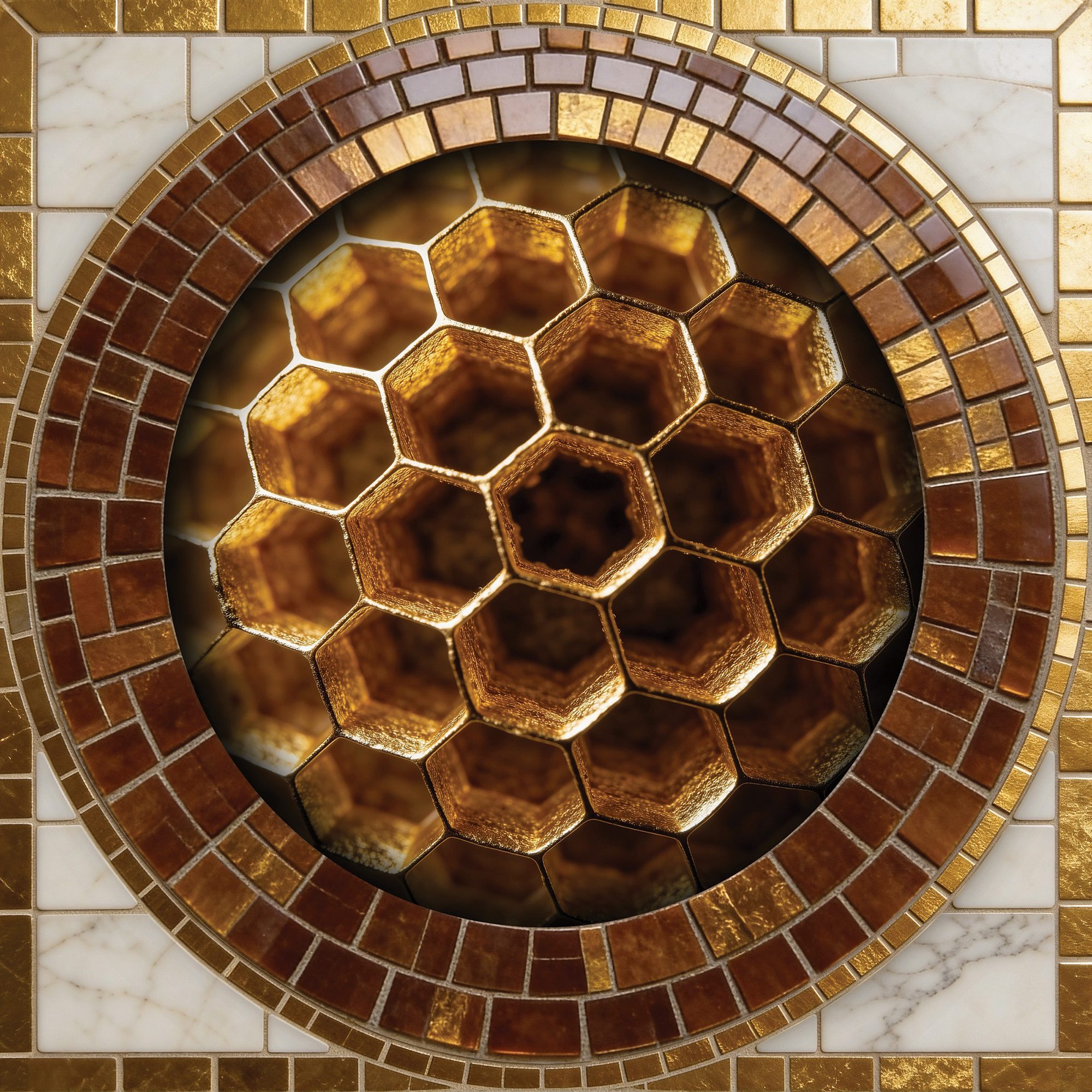
The idea that geometry underlies creation predates Freemasonry. Circa 360 BCE, Plato proposed that matter was composed of geometric atoms, or “solids.” Later, in the early 17th-century, the German astronomer and mathematician Johannes Kepler identified similar patterns in the natural world. In his essay “The Six-Cornered Snowflake,” published in 1611, he observed that honeycombs were constructed on a six-sided plan, with each cell sharing its walls with six others, creating what he described as “close-packing rhomboids.”
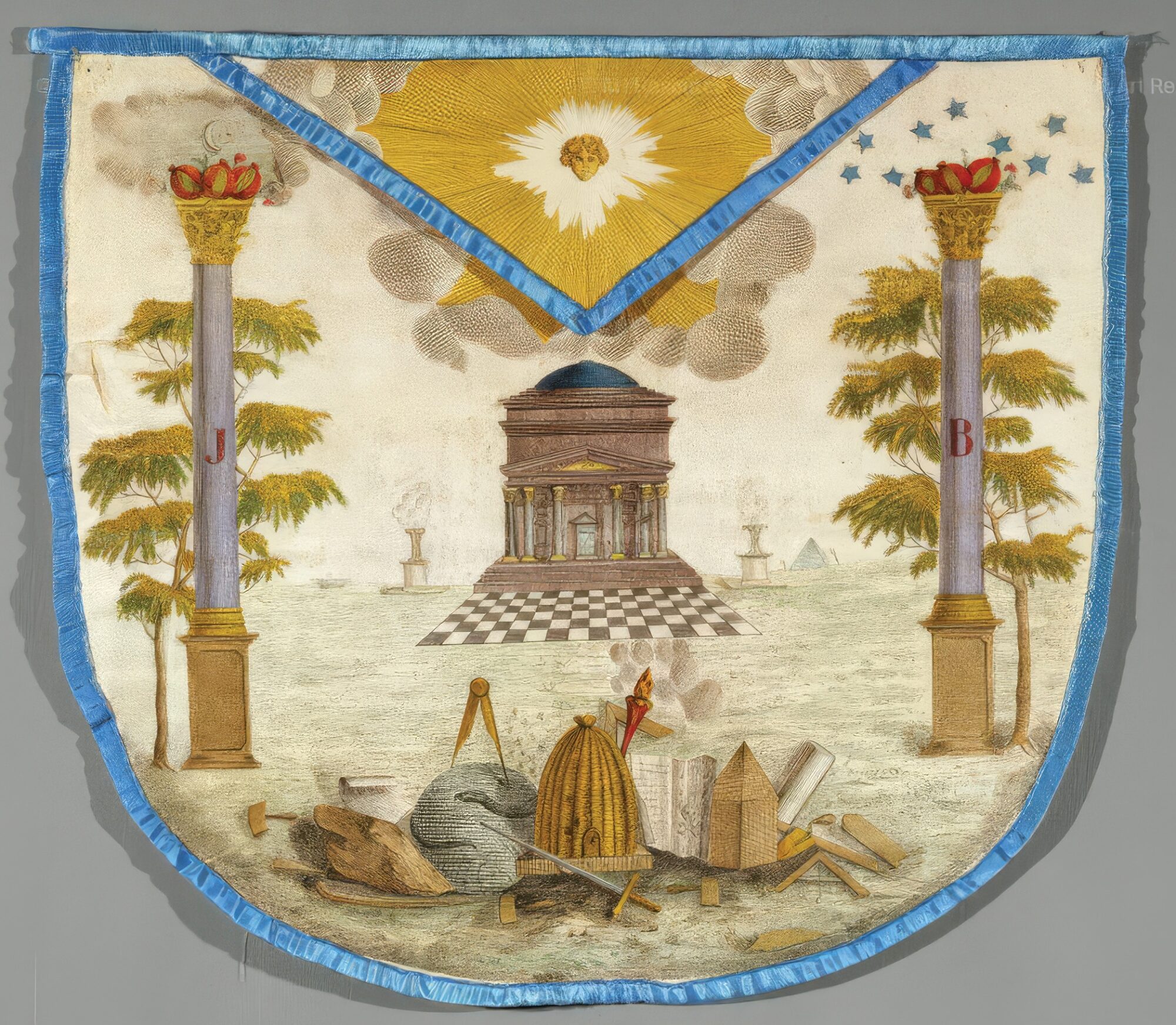
He noted a comparable arrangement in the pomegranate, with clusters of seeds pressed into rhomboidal cells. These examples point to natural systems that follow observable patterns; forms like the pomegranate and the beehive often appear in Freemasonry. For Kepler, such structures suggest a rational underlying principle attributable to the Great Architect.
Illustrations by:
Eddie Guy
Photo courtesy:
United Grand Lodge of England
Erich Lessing / Art Resource, NY
As the Masonic Home at Covina evolves, renowned midcentury architect A. Quincy Jones’s vision guides a campus built for community and care.
In San Diego, one newly raised Mason became a Foundation donor in less than a year.
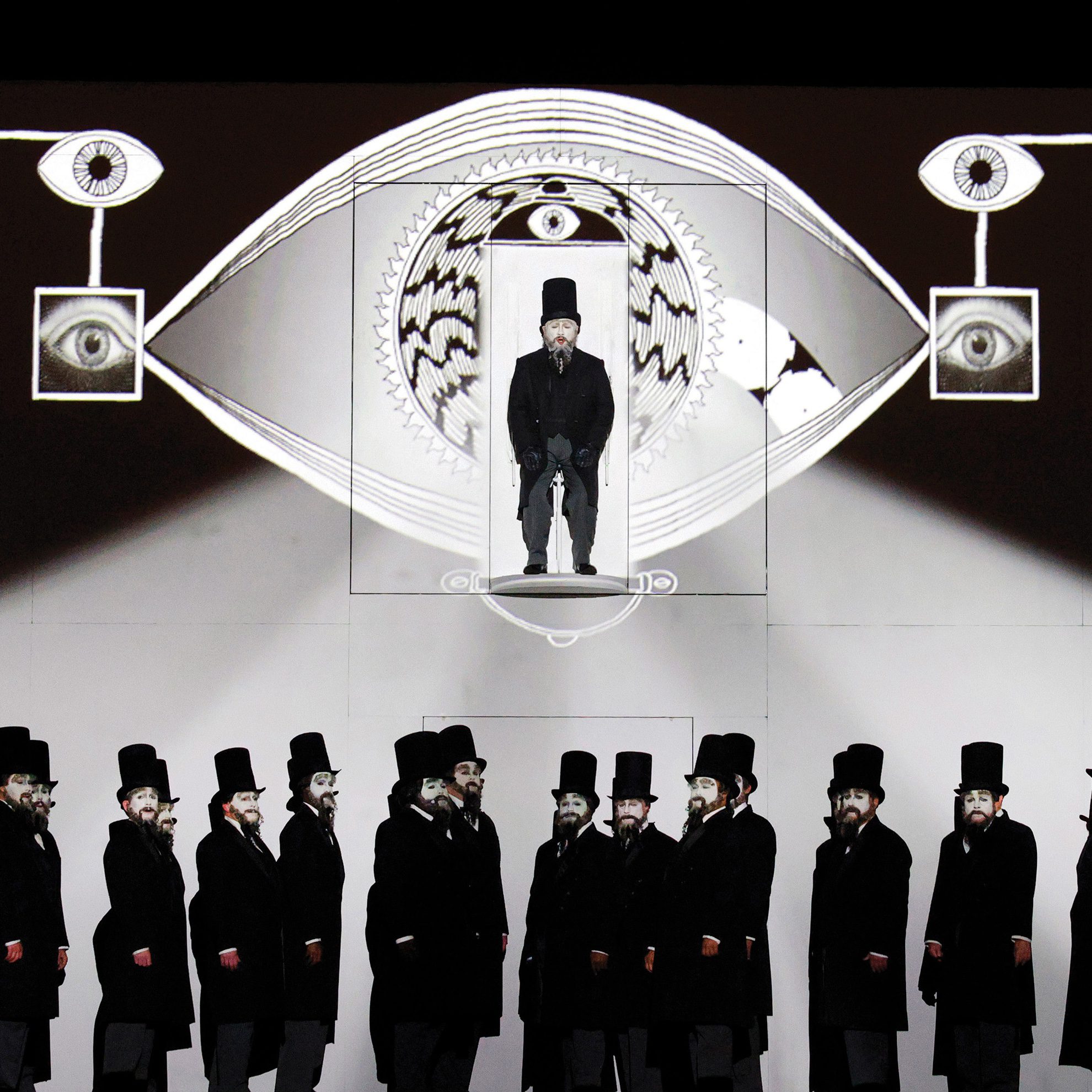
In The Magic Flute, musical genius and Masonic ideals converge.