Stret Cred

Lodges become canvases for local history, symbolism, and civic pride.

By Cynthia J. Drake

Across California, Masonic lodges have commissioned large-scale murals for their exteriors, using their facades as a public form of expression for an institution that largely operates out of view. Frequently offered as gifts to the community, these murals draw on local lore, flora, and fauna, often embedding Masonic symbols at diverse scales, some unmistakable, others easy to miss. Here, a selection of murals—rooted in place, painted for the people—shows how lodges can become landmarks.

Out of Time

SACRAMENTO № 40
1123 J Street, Sacramento

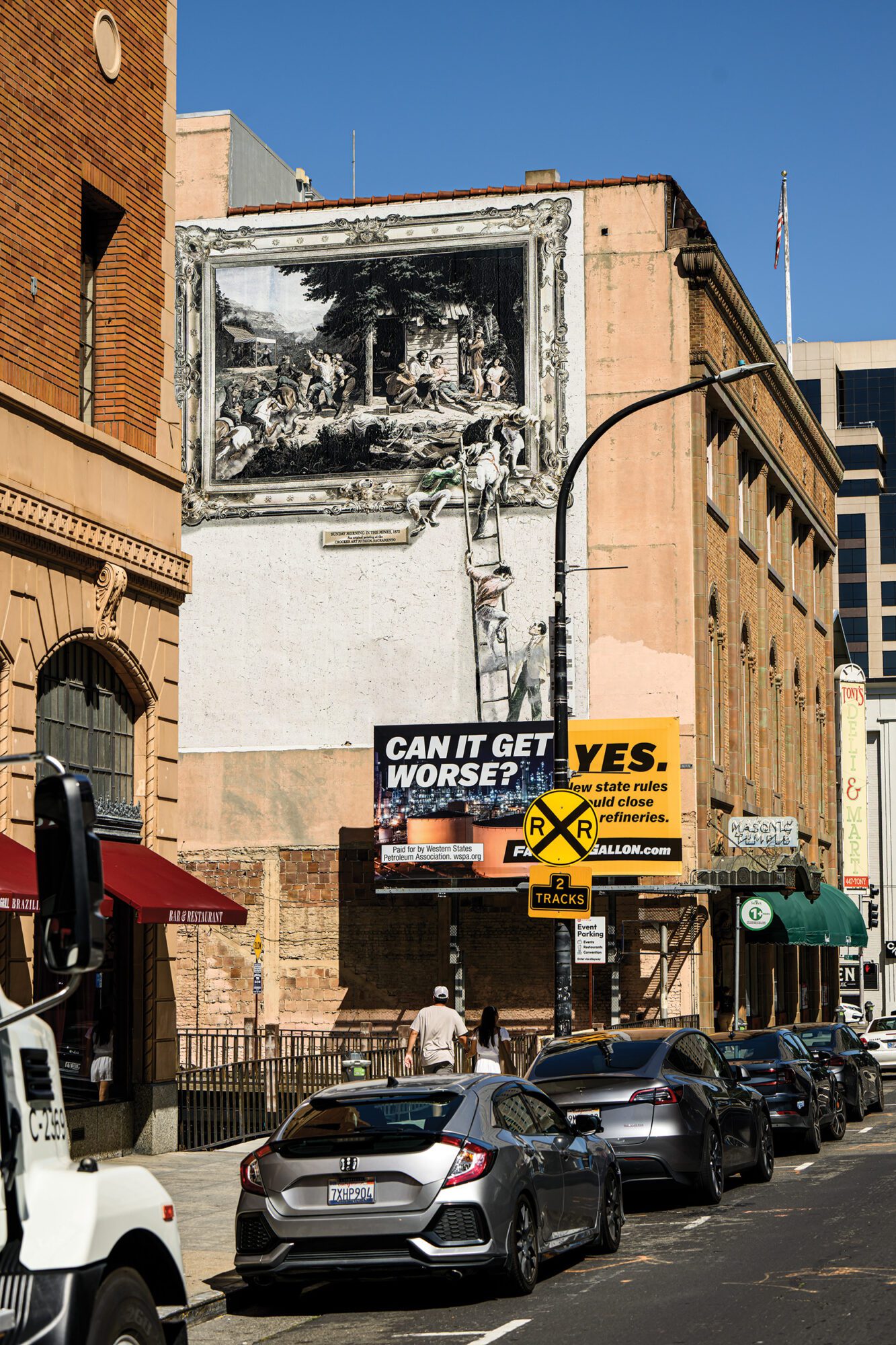
Sunday Morning in the Mines, an 1872 oil painting by Charles Christian Nahl (whose bear graces the California state flag), contrasts Gold Rush–era miners reading from a Bible and doing laundry with men who smoke, drink, gamble, and fight. The original hangs in the Crocker Art Museum just a few blocks away, but a reproduction—with a circa-1997 intervention—covers the exterior of the Sacramento Masonic Temple

Local artist Stephanie Taylor’s mural adaptation, Monday Morning in the Mines, is a largescale digital print on canvas adhered to the facade of the 1920 lodge—“It’s the first thing you notice about the building,” says Blake Green, master of Sacramento № 40—standing apart from the nearly 300 painted murals in the city. “It brings a contemporary lens to the past, asking what life was really like for miners,” says Taylor, who added figures climbing in and out of the scene, two in modern clothing. “That idea of carrying tradition into a modern world is very Masonic,” adds Green.

Above: Members gather in January 2026 for the installation of officers for Palm Springs № 693.

Eye in the Sky

VESPER LODGE № 84
822 Main Street, Red Bluff

At Vesper Lodge № 84 in Red Bluff, a town along the Sacramento River, a horned owl spreads its wings across a mural designed by Shasta County artist Carl Avery and painted by the local artist collective Tehama Creatives in 2020, part of a larger effort to transform a downtown alley into a corridor of public art. Spanning 2,700 square feet, the work cuts across the building’s panes: The owl’s body and wings cross window openings, while gold trim traces a star—suggestive of the blazing star—through the composition.

Set against a saturated blue background, the work contains iconography that extends beyond Masonic symbolism. At the center, the all-seeing eye sits within the square and compass, ringed by lunar phases and a flaring sun: knowledge, order, and time in alignment. Above, the letter “G”— geometry and God—holds steady, illuminated. “The mural serves as a bridge between our lodge and the community, offering a visual invitation to reflect on deeper ideas and shared human values,” says Master Cameron Ellis.

The Long View

SOTOYOME-CURTIS № 123
324 Center Street, Healdsburg

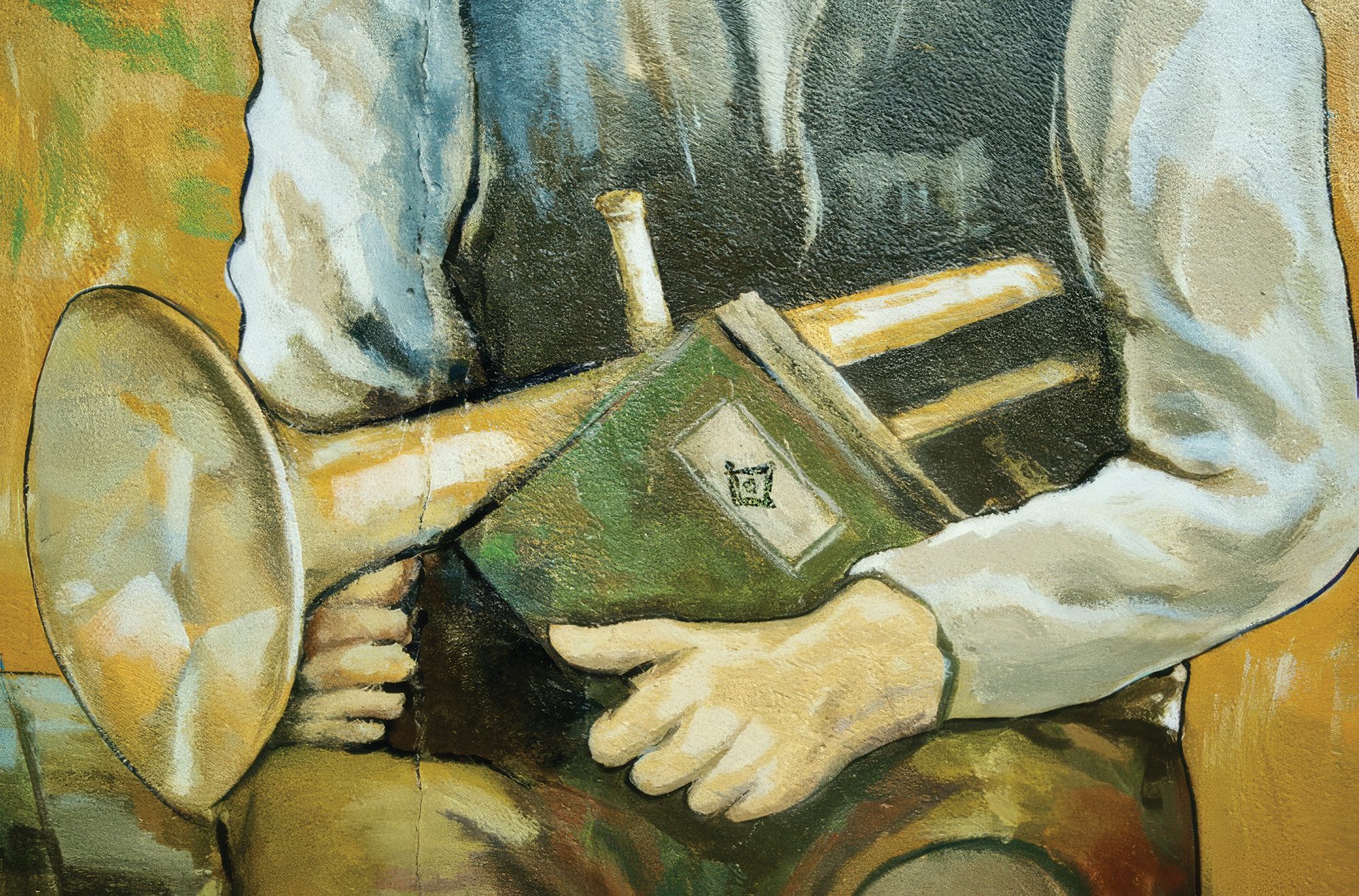
In 2007, the Sonoma County town of Healdsburg and Sotoyome-Curtis № 123 were both celebrating their 150th anniversary. Members of the lodge marked the occasion by commissioning a mural as a gift to the community, painted by Healdsburg artist Carlos Raul Perez. Spanning the lower level of the Plaza Street building, the untitled work—rendered in a pastoral palette of dusty greens, muted golds, and soft blues— traces local history, beginning with the area’s Indigenous roots and moving through agriculture, Prohibition, and the present day, represented by a town square filled with people and music.

The square and compass, pre-vandalism.

Rather than separating these different eras, the mural runs them together them into a continuous scene—everything, everywhere, all at once. In the foreground, a trombone player holds a book once emblazoned—since vandalized— with the square and compass; the man with a glass of wine is the late Robert Young of Robert Young Winery, who was a Mason, says Ted Elliott, past master of the lodge. He notes that the mural reflects how closely the lodge’s history and the surrounding community are intertwined. “Healdsburg’s respect for the Masons is huge,” he says. “If you look at our members’ names throughout history, they coincide with a lot of street names in town.”

Above: Members of Napa Valley № 93 stand taller in their tuxes.

The Hive Mind

CONFIDENCE № 110
3001 N. Main Street, Soquel

At the intersection of Soquel Drive and Main Street in Soquel, a golden honeycomb anchors a mural titled The Great Architect (2025), an 18-by-50-foot design set against a blue background that reads as both sea and sky. Bees and flowers gather at a hive’s edges, while hexagonal cells bring redwoods, a breaking Monterey Bay wave, and human workmanship— stonecutting and toolmaking—into the ecosystem.

Santa Cruz artist Rachel Barnes ideated with Confidence № 110 to create the piece on the side of its windowless lodge building. The work took about a month to complete. “To us as a Masonic lodge, the bees have a greater significance. They represent the work we do together, the harmony we strive for in our interactions, and the product of consistent, concerted effort,” says Past Master Peter Cardilla. “When it was finished, it exceeded even my most optimistic expectation.”

Cleared for Launch

EL SEGUNDO № 421
520 Main Street, El Segundo

When a work of street art has been part of a town’s landscape for so long, it can fade from view. That was the case with Spirit of Aerospace, a 30-by-118-foot mural painted in 1997 on the side of the El Segundo Masonic Center by artist Scott Bloomfield, in recognition of the Los Angeles suburb’s contributions to the U.S. space program—more than half of all satellites and spacecraft are made there. 

Rendered in a cosmic palette of deep blues and blacks, the mural shows a glowing Earth and a shuttle mid-launch, with portraits of aviation trailblazers Amelia Earhart, the Wright brothers, and Howard Hughes amid the present-day industry they helped shape. To revive the work, El Segundo № 421 made the wall available for a 2024 augmented-reality update. “We were really trying to boost its signal,” says Christian Enriquez, owner of L.A.-based Reality Experience Design, which has developed augmented-reality features for a dozen El Segundo murals. Accessed through a QR code (above), the virtual mural comes alive— a space shuttle lifts off, the Earth spins, and a satellite drifts in orbit, turning a static historical tribute into something closer to a NASA training simulation.

Photography by:
Timothy J. Meyer
Winni Wintermeyer
USC Digital Library
Robin Dunitz,
Los Angeles Mural Collection
Confidence No. 110

more from the archives: