of togas and tilers

on college campuses, a fraternity within the fraternity

BY IAN A. STEWART

As forty-odd undergrads, all dressed in suits and ties, lined up in neat rows for their fraternity’s annual photo, the cracks in their smiles were already starting to show. Within moments, formality had given way to hilarity, the irrepressible goofiness of 19-, 20-, and 21-year-olds ultimately winning out.
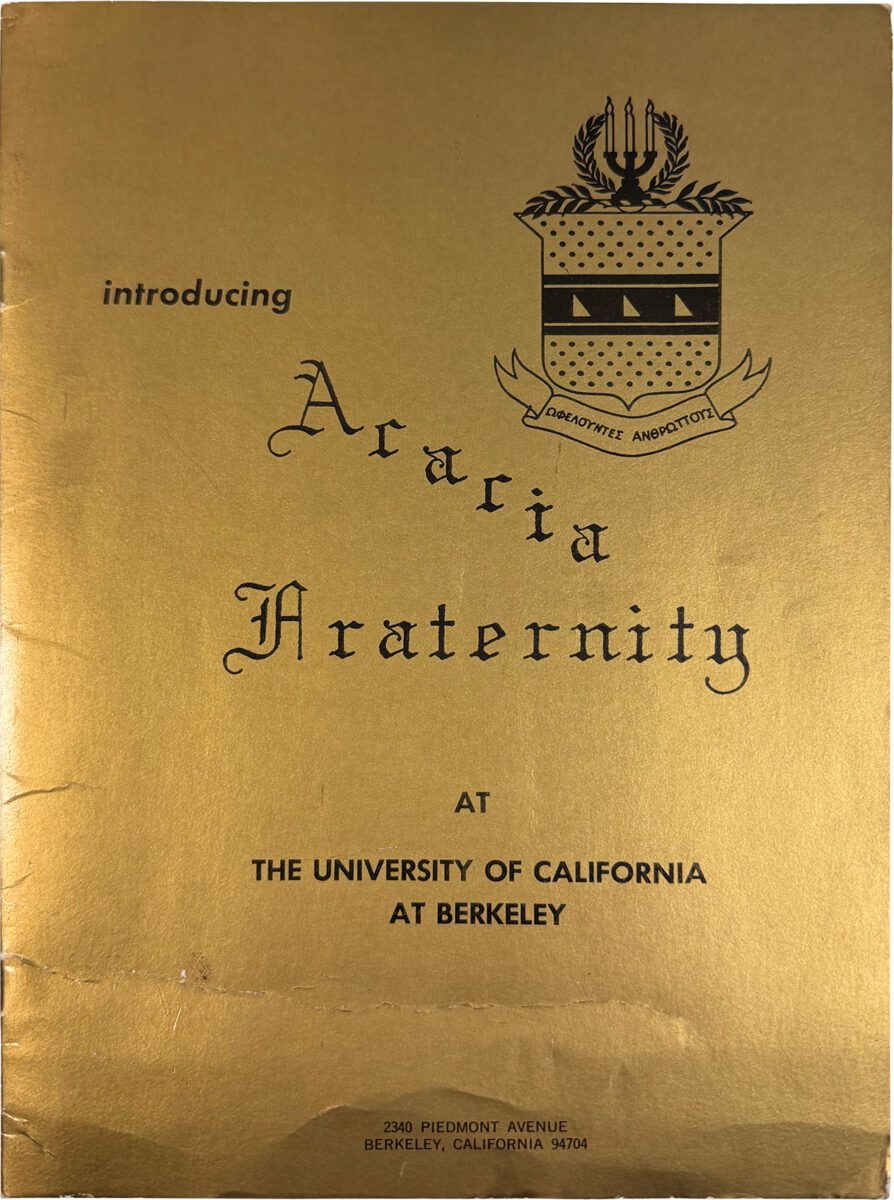
Similar scenes have no doubt played out countless times at Acacia house, the historically Masonic fraternity at UC Berkeley first launched in 1905. While no longer a strictly Masonic organization, Acacia Fraternity—Cal’s is the longest-running chapter of the national group—retains a distinct, if symbolic, connection to Freemasonry. Indeed, the group’s annual photo is still staged inside the lodge room of nearby Oakland № 61.

Though today the Masons don’t typically have much of a presence on college campuses, Acacia Fraternity is a reminder of a time when they most decidedly did. The first chapter was founded in 1904 at the University of Michigan by members of that group’s Masonic Club, comprising students who’d already taken the degrees. Within a few years, chapters had launched at colleges throughout the country, including Stanford (1904) and the University of California, Berkeley (1905). All told, there have been Acacia chapters at 95 universities, with 24 remaining active today. During the middle of the century, San Jose State, UCLA, Cal Poly, and Cal State Long Beach all established chapters.
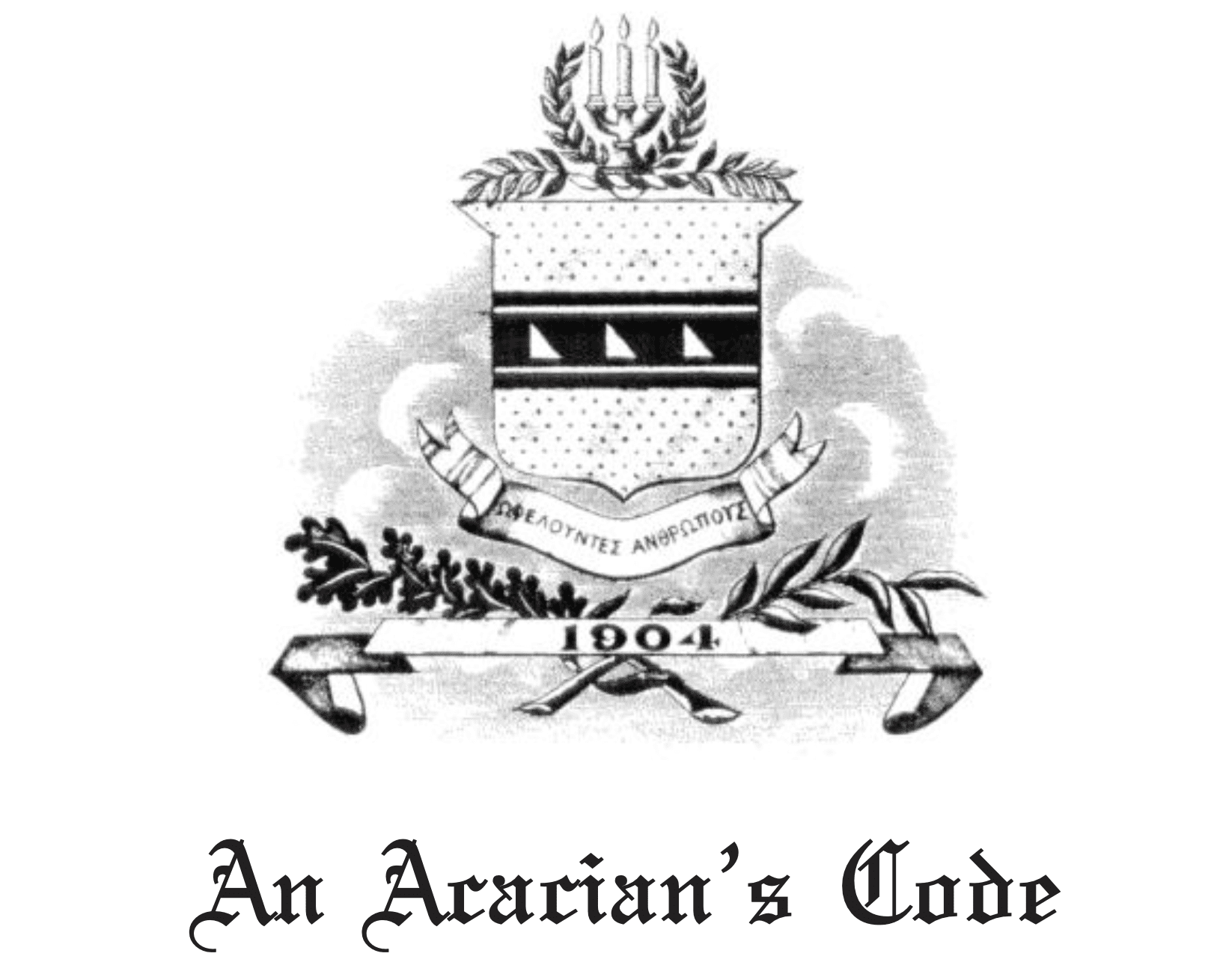
The group’s seal, translated from the Greek, means “in service of humanity.”

Unlike theirs, however, the Cal chapter has endured, despite some periods of dormancy. (The same cannot be said of two other Masonic landmarks: the school’s old Masonic Clubhouse, which closed in the 1960s, and Henry Morse Stephens № 541, the former university-focused lodge, which consolidated a decade later and is now part of Bay Cities № 337.) Today the chapter counts 50 members, who live together in a Julia Morgan–designed house on Pied-mont Avenue—the exterior of which was redesigned in Greek Revival style in the 1950s—right in the heart of the city’s fraternity row.

Almost from the first, the group was met with a hearty endorsement from the state’s Grand Lodge. In 1914, Grand Master John D. Murphey was invited to dinner at the house, and he wrote in that year’s Proceedings, “I was much impressed with the earnest and conscientious demeanor of the thirty or more young Masons whom I found to constitute the membership of this fraternity, and I could readily appreciate the power for good that they must exercise in the university community.” He then advocated for “some benevolently disposed Masons who possess the means to justify it” to help the group purchase its own house. Later, in the 1980s, the group took over the site at 2340 Piedmont that it currently occupies, and in 1993 Grand Master Stephen Doan rededicated the house in a Grand Lodge ceremony.


The other major change to the fraternity during the 1930s, when the requirement of Masonic membership was dropped for incoming pledges, in favor of a recommendation from two Master Masons. This was the result of a general plummeting of college enrollment at the time, after the first swell of postwar students had matriculated. Since then, Acacians have “more of a spiritual connection to Masonry,” says Benjamin Turconi, the national fraternity’s executive director of communications. Turconi is a 2012 alumnus of the Cal chapter and was raised as a Master Mason in Windsor 181. “We have a lot of people who get introduced to Masonry through Acacia—they get some exposure to it where otherwise they might never have heard of Freemasonry,” he says.

Perhaps the most notable contemporary connection between the college fraternity and the speculative one is Past Grand Master John Cooper. Cooper joined the UCLA chapter of Acacia in 1963, where he earned the Acacian DeMolay Scholarship that paid for his room and board. As a college senior, he served the fraternity as venerable dean and secretary of the Interfraternity Council, and the following year was initiated into Azure № 533.

“I made some great friend-ships in Acacia—people I still stay in touch with,” Cooper says. “That’s what fraternities are all about. Sometimes they get a bad reputation, but I’m a firm supporter. You know, we had a lot of fun.”

Photography by:
Lance Yokota
Henry Wilson Coil Library and Museum of Freemasory

TOP: MEMBERS WITH 16 NEW INITIATES, ON NOV. 8, 2025. 

more from the archives: